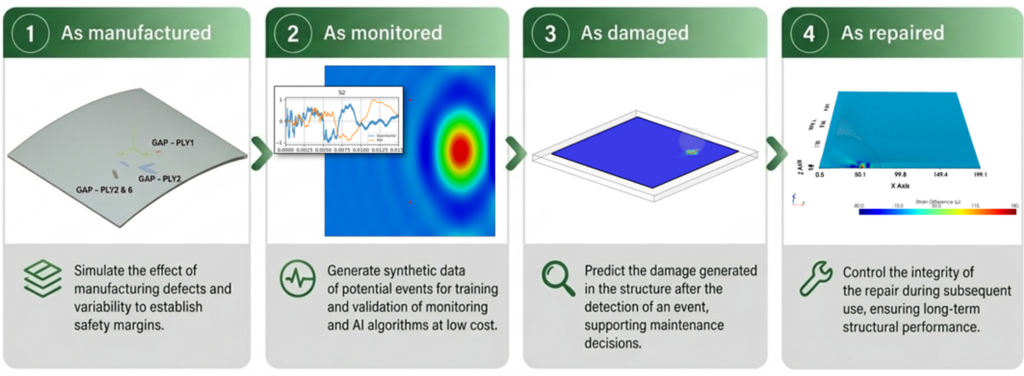
Within the TOSCA project, computational simulation is a key enabler for building a comprehensive digital twin of composite aeronautical structures throughout their lifecycle. Using advanced Finite Element Analysis (FEA), virtual models can replicate the structural behaviour of components under realistic operating conditions, providing engineers with valuable insights that would otherwise require costly experimental campaigns.
In the “as-manufactured” stage, simulations are used to assess the impact of manufacturing defects and variability on structural performance, helping to establish safety margins and improve confidence in certification processes. At the “as-monitored” stage, virtual models generate synthetic data associated with potential events and damage scenarios, creating large and cost-effective datasets for training and validating monitoring and artificial intelligence algorithms.
The digital twin continues to evolve through the “as-damaged” and “as-repaired” stages. Following the detection of an event, simulations help predict the extent and characteristics of the resulting damage and how it will evolve over time, supporting maintenance decisions and inspection planning. After repair, computational models are employed to evaluate the long-term integrity of the restored structure, enabling continuous assessment of repair effectiveness and ensuring safe operation throughout the remaining service life of the component.